
Which Business Areas Are Affected by GEO
Generative Engine Optimization (GEO) is currently evolving in B2B from a niche SEO topic into a strategic cross functional discipline. Visibility is no longer created solely through traditional search engines. More and more research and decision making processes now begin in generative AI systems such as ChatGPT, Gemini, or Perplexity.
- 1. What B2B GEO Is and Why It Is Becoming Strategically Important for Companies
- 2. What Is Changing in B2B Marketing as AI Usage Grows?
- 2.1 The Potential Is Almost Unlimited, Because AI Is Still Only at the Beginning
- 3. How B2B GEO Differs from Traditional SEO
- 4. Which Business Functions Are Most Affected
- 5. Why Traditional SEO Structures Are Often No Longer Enough
- 6. GEO Is Also Changing the Role of PR and Brand
- 7. Why Problems in Knowledge Management Are Suddenly Becoming Visible
- 8. How Companies Can Get Started with B2B GEO
- 9. Which Services Agencies Offer for B2B GEO
- 10. When a B2B GEO Agency Makes Sense
- 11. How Companies Can Identify a Qualified B2B GEO Agency
- 12. Typical Red Flags in B2B GEO Agencies
- 13. Where B2B GEO and B2C GEO Differ
- 14. How GEO Changes Companies in the Long Term
What B2B GEO Is and Why It Is Becoming Strategically Important for Companies
In B2B, GEO (Generative Engine Optimization) refers to the optimization of digital content and company information for AI powered search and answer systems. The goal is no longer only to improve rankings in search engines, but to increase the likelihood that companies appear in AI generated answers at all, are categorized correctly, and are considered a relevant source.
This changes how companies are perceived digitally, especially when they offer complex B2B products. AI systems do not only evaluate individual web pages. They try to understand relationships: Which topics does a company own? How consistent is its communication? Which expertise is confirmed externally? And how well is its content structured?
For many companies, this creates a new challenge. GEO no longer affects only SEO teams, but increasingly also content, PR, product marketing, knowledge management, and sales.
What Is Changing in B2B Marketing as AI Usage Grows?
In B2B, purchasing decisions have always been highly information driven. Potential customers conduct their own research, compare providers, read expert content, and try to understand complex topics as well as possible before making contact.
What is new, however, is that AI systems are increasingly serving as the first layer of orientation. Today, someone searching for ERP systems, IT service providers, or specialized software solutions often no longer receives a traditional list of search results, but prewritten classifications, recommendations, or summaries.
This fundamentally changes the logic of digital visibility. Companies are no longer competing only for rankings, but for whether they appear in AI generated answers at all. This becomes especially relevant for companies with complex services, long decision cycles, and a high need for consulting. In those cases, digital visibility influences the perception of potential customers at a very early stage.
The Potential Is Almost Unlimited, Because AI Is Still Only at the Beginning
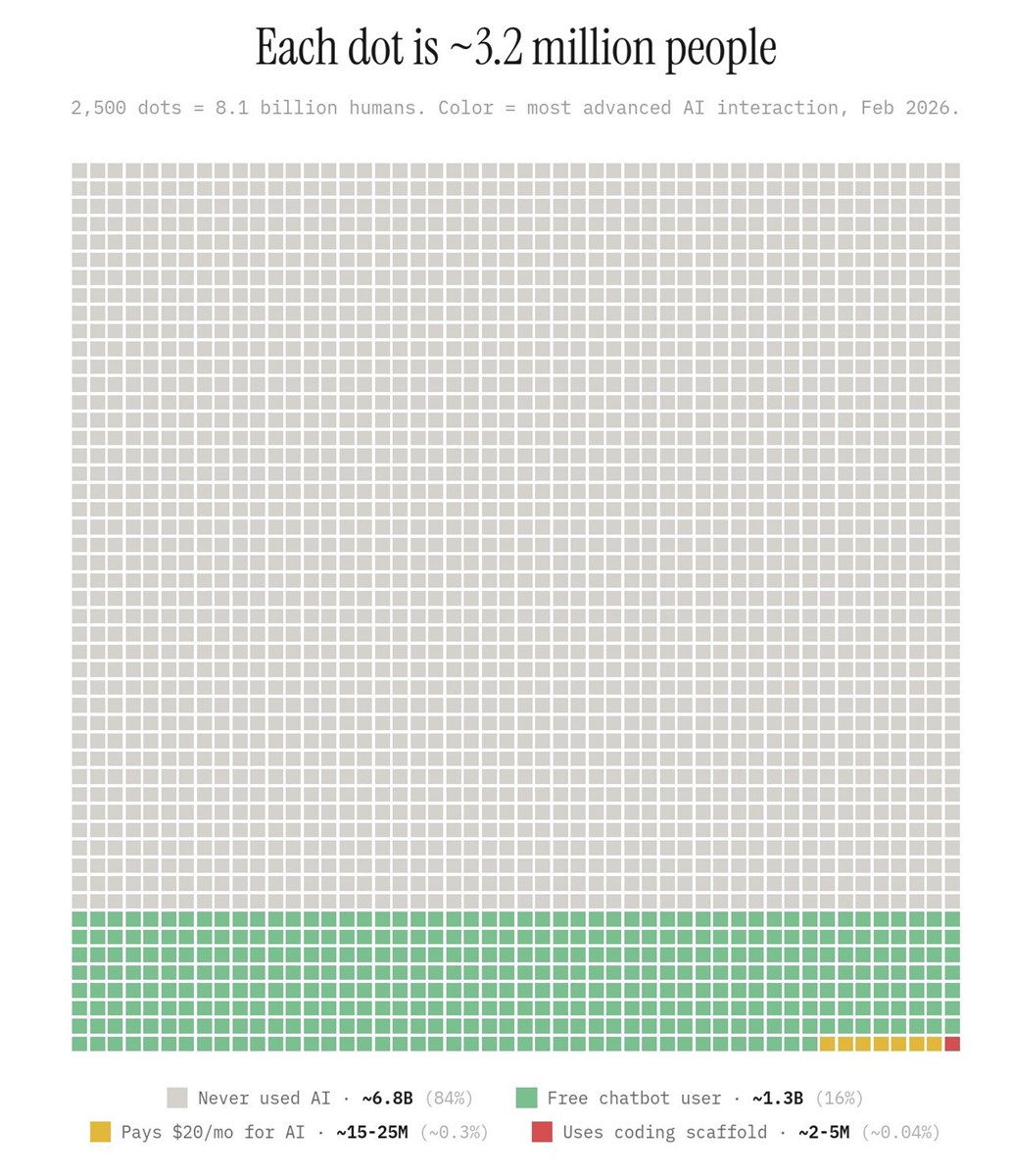
The graphic illustrates that despite the high level of public attention, generative AI is currently still actively used by only a small share of the global population. At the same time, current developments suggest that AI powered information systems and answer formats will become significantly more important in the future. This also applies to knowledge intensive B2B topics and digital visibility.
How B2B GEO Differs from Traditional SEO
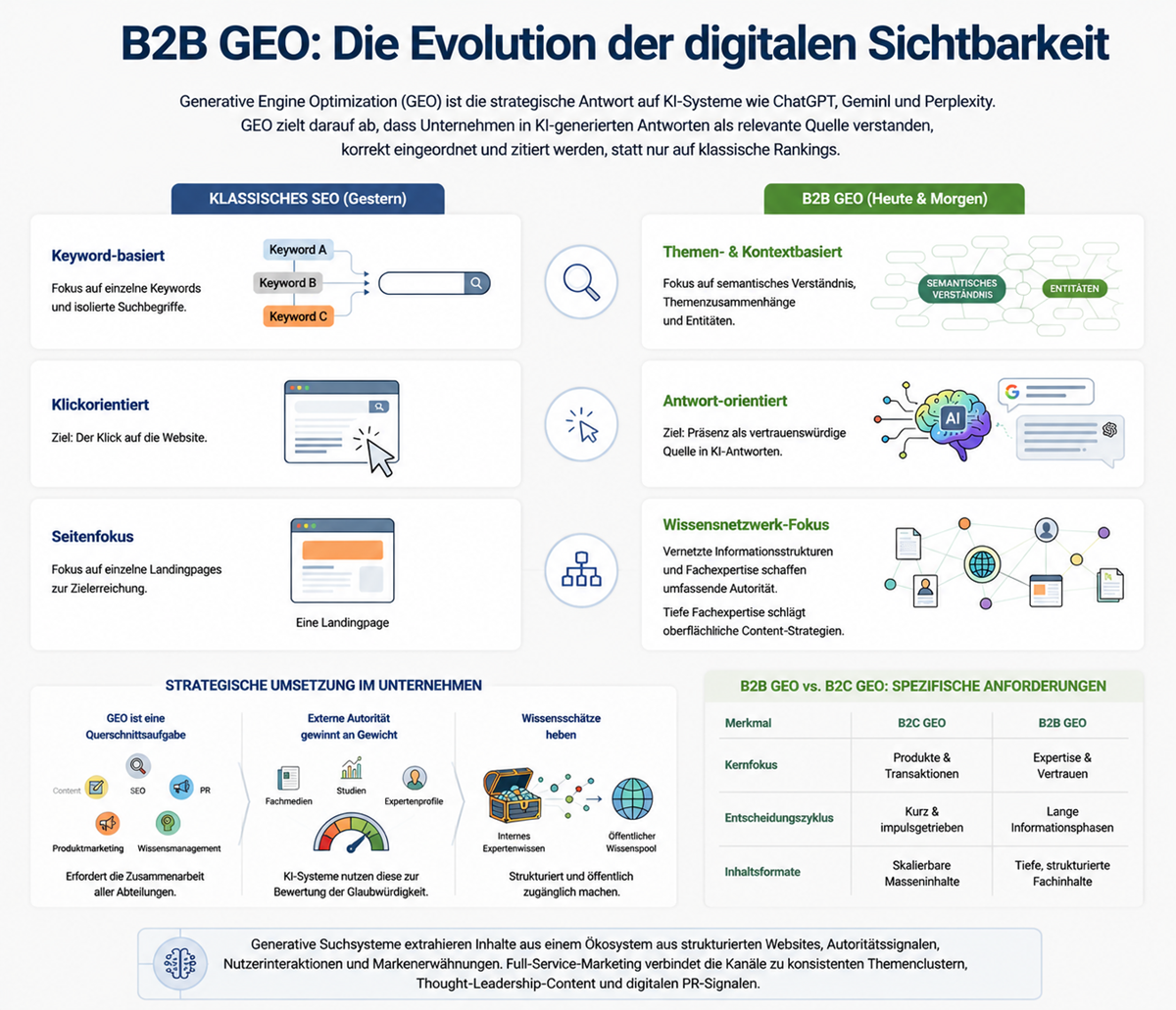
Many discussions around GEO are still heavily based on traditional search engine optimization. In reality, however, the underlying logic is shifting significantly.
Traditional SEO | B2B GEO |
Focus on rankings | Focus on AI mentions and source relevance |
Keywords are the main focus | Topic understanding and entities become more important |
Clicks are the central metric | Visibility within answers becomes more important |
Individual landing pages dominate | Connected knowledge structures become more relevant |
Search engines are the primary target systems | AI systems become additional intermediaries |
Especially in B2B, this means that superficial content strategies are increasingly losing their effectiveness. Many generic thought leadership articles may generate visibility on social networks, but often provide too little subject matter substance for AI systems.
Instead, content that conveys real expertise is becoming more important: technical explanations, specific use cases, structured expert articles, or transparent problem solving.
Which Business Functions Are Most Affected
The organizational challenge of B2B GEO lies mainly in the fact that visibility now emerges in several places at the same time. Content, brand perception, product communication, and external trust signals are more closely connected than they were in traditional SEO. The following overview shows which business functions are particularly affected and why.
Business Function | Role in the GEO Context | Typical Challenge |
SEO | Make content technically and semantically understandable | Focus is often still heavily on rankings |
Content Marketing | Prepare subject matter expertise in a structured and citable way | Content often remains too superficial |
PR & Communications | Strengthen external authority and trust signals | Lack of presence in industry media |
Brand & Positioning | Clearly communicate topical ownership | Inconsistent brand messaging |
Product Marketing | Explain products clearly and with differentiation | Complex services are described unclearly |
Knowledge Management | Systematically document company knowledge | Knowledge is spread across silos |
Sales Enablement | Create consistent communication in sales | Different levels of knowledge across teams |
Customer Education | Guide and educate customers on subject matter topics | Lack of educational content |
In practice, it often becomes clear that GEO problems are rarely pure SEO problems. Many companies have relevant subject matter expertise, but they do not publish it in a form that is understandable for both users and AI systems.
Why Traditional SEO Structures Are Often No Longer Enough
SEO remains important in the GEO era, but the focus is shifting significantly. While traditional search engine optimization was long centered around keywords and rankings, GEO is more strongly focused on semantic clarity and digital authority. AI systems do not only try to index content. They try to classify it from a subject matter perspective. As a result, what matters includes whether content answers specific questions, how consistently topics are communicated, and which external sources confirm a company’s expertise.
Especially in B2B, this means that many existing content processes are reaching their limits. Content is often produced around campaigns, while generative systems tend to prefer structured knowledge sources. In the long term, this requires companies to shift their perspective: away from isolated individual pieces of content and toward consistent knowledge structures.
GEO Is Also Changing the Role of PR and Brand
This development becomes especially clear in the field of digital PR. AI systems do not only evaluate content on a company’s own website. They also include external mentions and trust signals in their assessment. Expert articles, studies, conference contributions, or interviews help generative systems classify companies by topic and infer authority. As a result, the boundaries between SEO, PR, and brand communication are becoming increasingly blurred.
For many companies, this creates a new area of tension: visibility can no longer be achieved solely through technical optimization. The question of how consistently a company is perceived digitally becomes just as important. Brand positioning plays a greater role here than is often assumed. AI systems often prefer companies that clearly communicate which topics they stand for and where they have expertise. Unclear positioning or contradictory service descriptions, on the other hand, make classification more difficult.
Why Problems in Knowledge Management Are Suddenly Becoming Visible
Knowledge management is an often underestimated area in the GEO context. Many companies have enormous subject matter expertise, but it is spread across internal documents, presentations, wikis, or individual employees. For AI systems, this knowledge practically does not exist as long as it is not documented in a structured way and made publicly accessible.
This creates a direct connection between internal knowledge management and external visibility for the first time. Companies that systematically document and publish subject matter expertise often create better conditions for B2B GEO than companies with purely marketing driven content.
This becomes especially relevant in technology driven industries or for complex services, where trust is built largely through expertise.
How Companies Can Get Started with B2B GEO
Many companies are still at the beginning and are first trying to understand what organizational impact GEO actually has. In practice, it becomes clear that a complete strategy shift is rarely necessary.
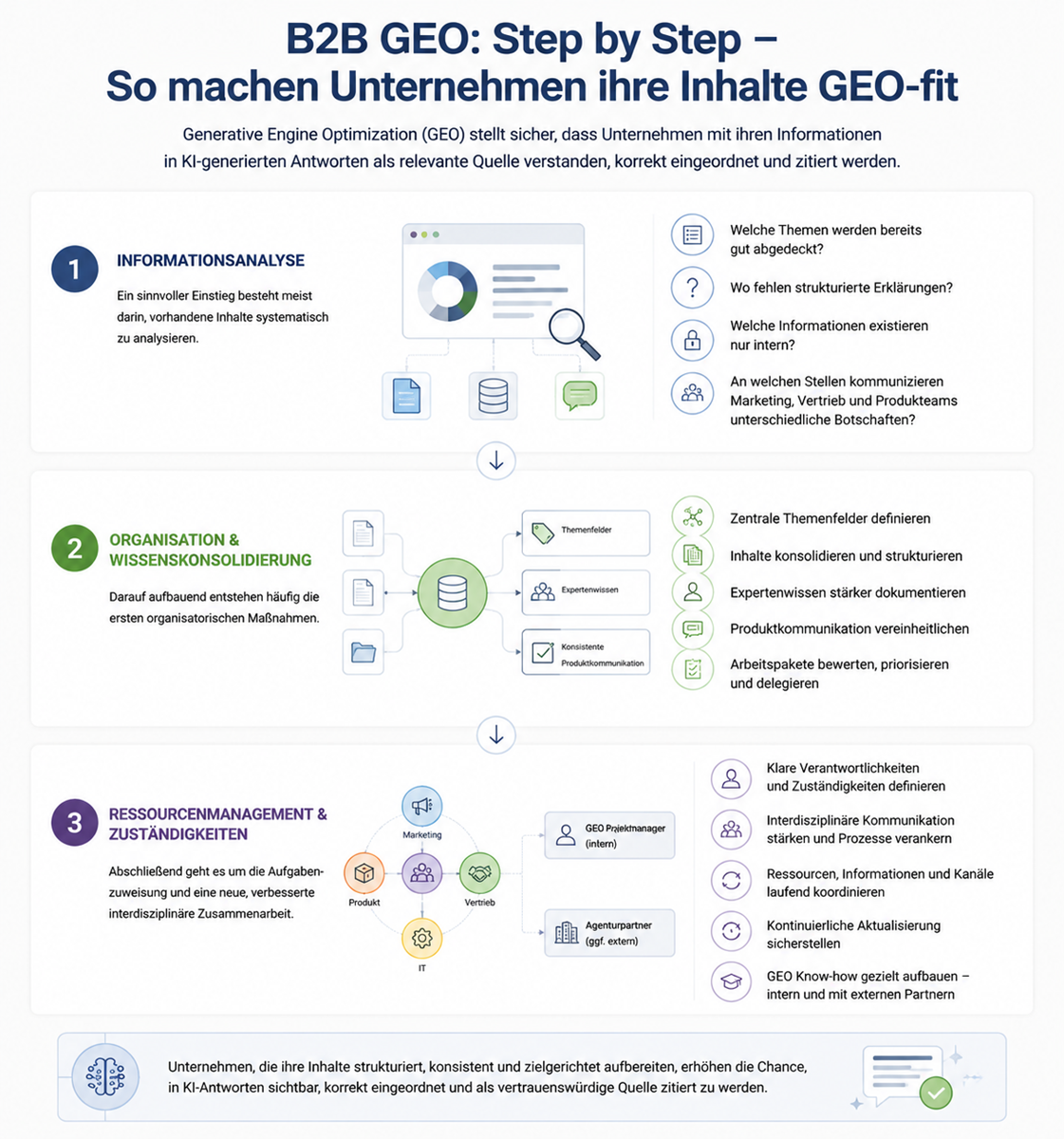
Often, the first step is to make existing knowledge structures more usable. Companies should proceed as follows:
Information Analysis
A useful starting point is usually to systematically analyze existing content. Which topics are already covered well? Where are structured explanations missing? Which information exists only internally? And where do marketing, sales, and product teams communicate different messages?
Organization & Knowledge Consolidation
Based on this, the first organizational measures often emerge. Companies define core topic areas, consolidate scattered content, and begin documenting expert knowledge more consistently. At the same time, product communication is standardized so that services can be described more consistently. Finally, there should be defined work packages that can be evaluated, prioritized, and delegated for implementation.
Resource Management & Responsibilities
Finally, the focus shifts to assigning tasks. This requires clear responsibilities for individual departments and people, but also new and improved interdisciplinary communication. For many companies, this is the biggest challenge for medium and long term success, because coordinating all resources, information, and channels is highly complex and constantly requires updates. Dedicated project managers with GEO expertise can support implementation internally, while agencies can provide external support with a trained perspective.
The most successful companies are usually those that do not treat GEO purely as an SEO project, but as a strategic initiative. It is about connecting content, communication, and knowledge management, not only in internal communication, but across all marketing channels.
Which Services Agencies Offer for B2B GEO
As GEO becomes more relevant, specialized consulting and agency services are also emerging. However, it quickly becomes clear that GEO in B2B rarely works as an isolated SEO discipline. Companies usually need a combination of strategic consulting, content expertise, technical structuring, and organizational execution. In addition to topics such as semantic content structuring or technical information architecture, communication strategy, topic positioning, and cross channel distribution are becoming more important.
Service Area | Typical GEO Services |
Content & SEO | Topic architectures, semantic content optimization, knowledge hubs, structured expert content |
PR & Brand | Industry media placements, expert positioning, digital authority, thought leadership |
Social Media | Distribution of expert content, topic amplification, development of expert profiles, and strengthening of social signals |
Paid Media & SEA | Topic validation, amplification of relevant content, audience insights, support for strategic campaigns, SERP domination in search engines, and in the future also AI ads, such as ChatGPT Ads, which are already active in the US |
Strategy & Governance | Project management, responsibilities, cross channel visibility, organizational integration |
Social media and paid channels play a more important role here than is often assumed. Visibility in generative systems does not arise only from a company’s own website, but increasingly from overall digital signals. These include discussions on LinkedIn, expert articles, mentions in industry media, expert profiles, or the consistent distribution of topics across different platforms.
SEA and paid media can also become indirectly relevant, for example for validating topic clusters, amplifying relevant content, or supporting thought leadership campaigns.
When a B2B GEO Agency Makes Sense
External support becomes especially relevant when companies need to coordinate several topics at once or lack internal expertise.
This applies in particular to companies with:
- complex product portfolios,
- multiple target audiences,
- international markets,
- long decision making processes,
- or a high dependence on organic visibility.
Organizational complexity also plays a role. As soon as multiple departments are involved, coordination problems often arise between SEO, content, PR, product marketing, and sales. A qualified agency can help establish shared structures and priorities. However, it is important that GEO is not viewed purely as an operational task. In B2B, it is rarely just about rankings or content production.
Common core questions include:
- Which topics should the company own in the long term?
- How can expertise become digitally visible?
- Which content do different stakeholders need?
- How can knowledge, brand, and visibility be connected consistently?
For this reason, strong GEO projects often differ significantly from traditional SEO retainers.
How Companies Can Identify a Qualified B2B GEO Agency
Because GEO is still in an early market phase, the quality of many offerings is difficult to assess. Providers that view GEO exclusively as a technical or purely content driven discipline are especially problematic.
In B2B, visibility today emerges from the interaction of many channels and signals. A qualified GEO agency therefore needs not only SEO expertise, but also an understanding of how content, distribution, brand perception, and demand generation work together.
Hard Skills | Soft Skills | |||||||||||||||||||||
|
|
AI systems do not interpret companies based on individual landing pages, but based on an entire digital ecosystem. This includes industry media, expert profiles, social signals, knowledge platforms, product pages, PR mentions, and the consistency of topics across different channels.
A qualified GEO agency is therefore recognized less by individual tool certifications and more by strategic breadth and the ability to bring different disciplines together.
Typical Red Flags in B2B GEO Agencies
Because GEO is currently a highly trend driven topic, many simplified or overly narrow offerings are emerging. Companies should therefore carefully examine how providers methodically approach GEO.
Red Flag | Why It Is Problematic |
GEO is sold exclusively as an SEO service | AI visibility emerges across channels and signals |
Focus on pure AI text production | Lack of subject matter depth and limited topical authority |
No connection to social media or PR | External trust and reputation signals are missing |
Exclusive focus on Google | Generative systems are viewed too narrowly |
Pure channel silos | Lack of coordination between SEO, content, paid, PR, and brand |
Heavily tool driven approach | Organizational and strategic factors are ignored |
Unrealistic “ChatGPT ranking” promises | GEO does not work like traditional ranking |
No experience with complex B2B markets | Long decision making processes and stakeholder structures are underestimated |
Siloed agency models are particularly critical. GEO now affects content, distribution, reputation, topical authority, and knowledge structures at the same time. Providers that optimize only a single channel often fall short.
Especially in B2B, trust is rarely created through reach alone, but through consistent expertise and clear topical positioning.
Where B2B GEO and B2C GEO Differ
The basic technical mechanisms of GEO are similar in B2B and B2C, but the requirements for content and visibility differ significantly.
In B2C, high search volumes, shorter decision cycles, and transactional search intent often dominate. Visibility there is often strongly shaped by reach, platform presence, product data, or commerce signals.
In B2B, research and decision making processes are much more complex. Purchasing decisions are usually made by multiple stakeholders, information phases last significantly longer, and trust plays a greater role than short term attention.
The differences become especially clear in the following comparison:
B2C GEO | B2B GEO |
Often shorter research phases | Often longer information and decision making processes |
Often product or transaction oriented | Often explanation and trust driven |
Platform and commerce signals are often relevant | Expertise and authority signals are more important |
Scalable content formats work more often | In depth expert content becomes more important |
While B2C often focuses on fast product comparisons or direct purchase decisions, B2B users are more likely to look for orientation, expert classification, and problem solving. Generative systems therefore need to be able to interpret complex topics correctly.
The role of content also differs significantly. In B2C, scalable formats with broad reach often work well. In B2B, by contrast, in depth content becomes more important, such as technical explanations, implementation knowledge, use cases, or educational content. At the same time, B2B GEO is usually much more closely connected to thought leadership, expert communication, and trust building. Companies are competing less for short term attention and more for subject matter credibility within complex decision making processes.
How GEO Changes Companies in the Long Term
In the long term, GEO changes not only digital visibility, but also the way companies organize and communicate knowledge. Expertise becomes more visible. Content becomes more structured. Company knowledge needs to be documented more systematically and made publicly understandable. At the same time, marketing, communications, and knowledge management grow closer together organizationally.
Especially in B2B, GEO may therefore be less of an additional marketing channel and more of a new framework for digital corporate communication as a whole. The central question in the future will no longer only be: “How do we rank on Google?”, but increasingly: “How is our company understood, categorized, and cited by AI systems?”

As Managing Partner and Head of Online Marketing and Design at DREIKON, Matthias Kampmann focuses extensively on the strategic development of digital visibility for companies. His work centers in particular on SEO, Generative Engine Optimization (GEO), content strategies, and the connection between marketing, technology, and AI powered information systems. As a member of the DIN SPEC consortium for the development of the DIN SPEC 33461 for SEO, he also contributed to the standardization of professional search engine optimization. Together with interdisciplinary teams, he supports companies in building digital knowledge structures, strategically consolidating content, and positioning themselves sustainably in an increasingly AI driven search and information landscape.


