
How to build an AI-based knowledge management system
Knowledge management consistently ranks among the top enterprise functions for agentic automation. The reason is fairly straightforward. Day-to-day tasks like searching for answers, reusing content, and connecting dots across teams naturally lend themselves to an AI boost.
Employees are already using a mix of AI tools to speed up work, often hopping between chats and interfaces. So why not give them a centralized, secure system?
Many organizations are doing just that with AI-powered knowledge management systems. This guide shows what these solutions deliver and how to handle their implementation.
- 1. What is AI-based KMS?
- 2. How AI agents transform knowledge management
- 2.1 Automated content curation and structuring
- 2.2 AI-powered search and contextual information delivery
- 2.3 Self-service insights and proactive assistance
- 3. Key benefits of an AI-powered knowledge management system
- 4. Challenges of implementing AI in knowledge management
- 5. Five fundamental steps to building an AI-based knowledge management system
- 5.1 1. Understanding the as-is state
- 5.2 2. Data preparation
- 5.3 3. Selecting the right AI stack
- 5.4 4. Model training
- 5.5 5. Launch and maintenance
- 6. Conclusion
What is AI-based KMS?
An AI-based knowledge management system (KMS) uses generative AI, machine learning, and agentic AI to capture, organize, retrieve, and deliver enterprise information assets automatically.
In practice, AI for knowledge management shows up in a few distinct ways, depending on how companies choose to embed it into everyday work:
AI agents embedded in systems like CRM or ERP, supporting employees directly in the working context,
Conversational assistants in Slack or Teams, handling questions and guiding tasks,
Centralized knowledge hubs with recommendation engines and AI-powered search.
How AI agents transform knowledge management
When you combine generative AI’s strength in information search and synthesis with autonomous agents that can act on behalf of employees, you unlock three high-impact use cases, each driving a new level of speed in how knowledge work gets done.
Automated content curation and structuring
Every time knowledge assets have to be manually gathered, filtered, and pieced together, it taxes the employee before the real work even begins. AI removes that upfront friction by:
- Capturing knowledge from a wide range of unstructured sources such as meetings, resolved support tickets, internal Q&A chats, etc.,
- Tagging and classifying both new and existing content automatically, using NLP,
- Curating knowledge assets by spotting outdated, duplicated, or missing content, then flagging it for review.
AI-powered search and contextual information delivery
Teams no longer rely on traditional search alone. They often turn to public AI chatbots, copying internal documents just to get answers. On the contrary, your proprietary knowledge management system keeps data secure while delivering precise, fast results through:
- Semantic search that interprets natural language queries, returning context-aware answers,
- Summarization that condenses long documents or multiple sources into clear, digestible overviews,
- Personalized content delivery that surfaces relevant pieces of content based on a user’s role, behavior, and current context.
Self-service insights and proactive assistance
What once meant sifting through documents or tracking down the right expert can now arrive in the hands of those who need it, right when they need it, thanks to:
- LLMs, identifying patterns in queries and revealing gaps or unclear content,
- AI algorithms, uncovering hidden insights by analyzing large datasets,
- AI agents, delivering round-the-clock support for employees and customers alike.
Key benefits of an AI-powered knowledge management system
Businesses that lean on AI to run their knowledge operations are harvesting wins across the board. Here’s what’s within reach.
Enhanced knowledge access. Instead of sifting through scattered documents or recreating work that’s already been done, employees can, with a single prompt, pull up past reports, proposals, answers, etc.
Accelerated decision-making. In a snap, AI-powered knowledge management systems surface relevant insights needed for a decision, whether for troubleshooting, planning, or design.
Streamlined onboarding. New team members can quickly get up to speed without hunting through scattered documents or relying on others to fill in gaps. The KMS delivers the right context and resources in a single place.
Boosted employee productivity. With AI-powered KMS, the time and effort employees spend searching for information is dramatically reduced. The immediate effect is less cognitive load, which allows them to execute tasks more efficiently.
Challenges of implementing AI in knowledge management
Before setting out to weave AI into knowledge management, know the common pitfalls that can throw even seasoned teams off course:
- Hallucinations
LLMs have a tendency to spit out factually wrong answers or misinterpret queries, making their outputs unreliable for decision-making or knowledge sharing.
Ground outputs in verified sources using RAG architectures, apply guardrails and validation frameworks, and fine-tune prompts and models on high-quality, domain-specific data. And always keep human-in-the-loop review as an option.
- Insufficient governance
Even accurate AI outputs can be inappropriate, sensitive, or non-compliant for certain users or contexts. Without clear rules, organizations risk misuse, exposure of confidential information, or regulatory violations.
Implement robust governance through role-based access, content classification, automated compliance checks, human-in-the-loop validation, and continuous monitoring of AI outputs.
- Employee resistance
Even the most sophisticated AI knowledge management system can stumble if employees resist adopting it. Habit, uncertainty, or skepticism can slow usage and limit impact.
Prepare teams for new ways of working, clearly communicate the system’s value, address concerns proactively, and secure buy-in from all levels.
- Uncontrolled costs
As AI models handle more queries and knowledge retrieval tasks, compute demand, storage needs, and API calls can surge unexpectedly, quickly inflating cloud bills and operational costs.
To keep spending predictable and under control, use automated scaling, workload orchestration, usage monitoring, and cost-alerting tools like AWS Auto Scaling, Kubernetes, or Datadog.
Five fundamental steps to building an AI-based knowledge management system
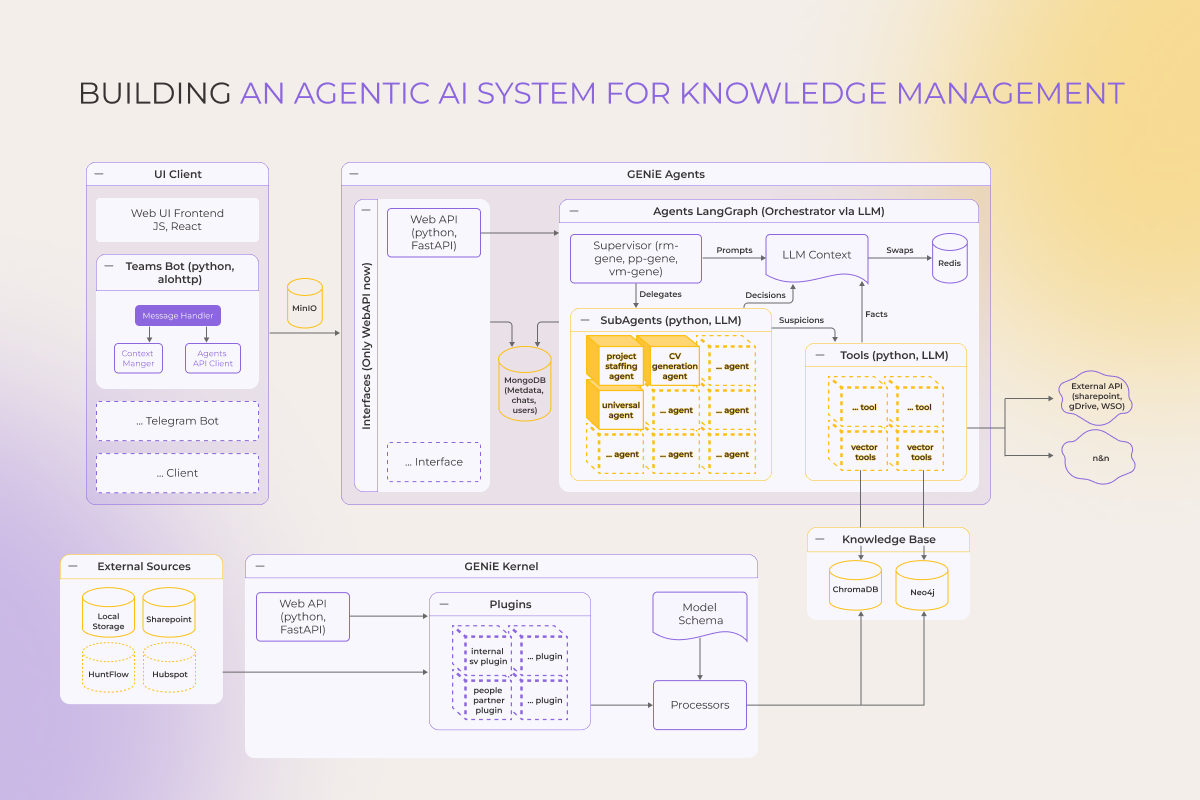
With typical challenges in mind, it’s clear that AI knowledge management system development isn’t about slapping a generic chatbot onto your existing systems and calling it a day. Real value comes from designing the solution around actual workflows and rolling it out with expert guidance every step of the way.
1. Understanding the as-is state
Start with an audit: is there existing knowledge management automation AI can enhance, or is information scattered and workflows ad hoc?
Organizations partnering with AI development companies typically start with a two-day AI adoption workshop. During the session, our experts pinpoint high-impact KM areas, anchor them in concrete use cases, and outline a feasible roadmap with budgets, timelines, and validation steps.
2. Data preparation
An AI knowledge system is only as strong as the data foundation it’s built on. Even if your data is centralized in a data warehouse, it isn’t automatically ready for AI. It may still need cleaning and structuring. Well-thought-out data preparation, spanning collecting, labeling, cleaning, and sometimes augmenting raw information, often takes up to 80% of the AI-powered KM development effort but determines the quality of every output.
3. Selecting the right AI stack
Building an AI-powered knowledge system requires a solid tech foundation:
- a foundational language model for reasoning,
- an orchestration layer to manage tools and workflows,
- a knowledge retrieval system (often a vector database) for semantic search,
- and an integration layer for user interaction.
4. Model training
AI doesn’t understand your business out of the box. It must be trained on real operational data and guided by governance. Choose between fine-tuning for precise behavior or retrieval-augmented generation (RAG) for flexibility and easier updates.
5. Launch and maintenance
Kick off with a small pilot. Let people test, poke holes, and speak up when things feel off. Watch how the AI fits into daily work, tweak based on feedback, then, and only then, scale. Use hands-on workshops, simulation sandboxes, and live help channels to get people comfortable and make the system part of their workflow.
Conclusion
A well-designed AI-powered knowledge system gives employees a single, secure place to find and act on knowledge, letting teams focus on meaningful work. Achieving this requires thoughtful AI development, grounded in proprietary data and guided by expert oversight.

As Managing Director of *instinctools in the U.S., Chad brings a deep commitment to creating impactful software that enhances everyday lives, from simplifying tasks to ensuring safety. He leads consulting efforts across USA, focusing on CRM solutions and product ownership, particularly in GenAI R&D projects. Working closely with teams and clients, Chad is dedicated to driving innovative solutions that make a real difference


